By synchronizing 98 tiny cameras in a single device, electrical engineers from Duke University and the University of Arizona have developed a prototype camera that can create images with unprecedented detail.
The camera's resolution is five times better than 20/20 human vision over a 120 degree horizontal field.
The new camera has the potential to capture up to 50 gigapixels of data, which is 50,000 megapixels. By comparison, most consumer cameras are capable of taking photographs with sizes ranging from 8 to 40 megapixels. Pixels are individual "dots" of data -- the higher the number of pixels, the better resolution of the image.
The researchers believe that within five years, as the electronic components of the cameras become miniaturized and more efficient, the next generation of gigapixel cameras should be available to the general public.
"Each one of the microcameras captures information from a specific area of the field of view," Brady said. "A computer processor essentially stitches all this information into a single highly detailed image. In many instances, the camera can capture images of things that photographers cannot see themselves but can then detect when the image is viewed later."
"The development of high-performance and low-cost microcamera optics and components has been the main challenge in our efforts to develop gigapixel cameras," Brady said. "While novel multiscale lens designs are essential, the primary barrier to ubiquitous high-pixel imaging turns out to be lower power and more compact integrated circuits, not the optics."
Details of the new camera were published online in the journal Nature. Co-authors of the Nature report with Brady and Gehm include Steve Feller, Daniel Marks, and David Kittle from Duke; Dathon Golish and Estabon Vera from Arizona; and Ron Stack from Distance Focus. The team's research was supported by the Defense Advanced Research Projects Agency (DARPA).
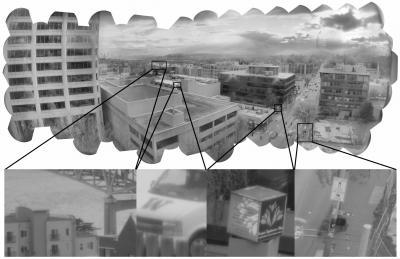 |
| This is a sample gigapixel image. |
The new camera has the potential to capture up to 50 gigapixels of data, which is 50,000 megapixels. By comparison, most consumer cameras are capable of taking photographs with sizes ranging from 8 to 40 megapixels. Pixels are individual "dots" of data -- the higher the number of pixels, the better resolution of the image.
The researchers believe that within five years, as the electronic components of the cameras become miniaturized and more efficient, the next generation of gigapixel cameras should be available to the general public.
"Each one of the microcameras captures information from a specific area of the field of view," Brady said. "A computer processor essentially stitches all this information into a single highly detailed image. In many instances, the camera can capture images of things that photographers cannot see themselves but can then detect when the image is viewed later."
"The development of high-performance and low-cost microcamera optics and components has been the main challenge in our efforts to develop gigapixel cameras," Brady said. "While novel multiscale lens designs are essential, the primary barrier to ubiquitous high-pixel imaging turns out to be lower power and more compact integrated circuits, not the optics."
Details of the new camera were published online in the journal Nature. Co-authors of the Nature report with Brady and Gehm include Steve Feller, Daniel Marks, and David Kittle from Duke; Dathon Golish and Estabon Vera from Arizona; and Ron Stack from Distance Focus. The team's research was supported by the Defense Advanced Research Projects Agency (DARPA).


No comments:
Post a Comment