A new study reveals that parts of Mars may have been modified by liquid water in recent geologic times, which might indicate more favourable conditions for life on the planet. Carried out by researchers from the University of Gothenburg, Sweden, in conjunction with German planetary researchers at Wilhelm’s University in Muenster and the Germany Aerospace Center (DLR) in Berlin, the study have now been published in the journal ICARUS, the International Journal for Solar System Studies.
The surface of Mars displays a diverse landscape, and a new study shows that large areas of the northern hemisphere have undergone a number of freeze-thaw cycles.
“This process is common in our own Arctic permafrost environments and causes the formation of lobate features on slopes,” says Andreas Johnsson at the University of Gothenburg’s Department of Earth Sciences. “As the Martian landscapes we’re studying feature ground-ice, our interpretation is that liquid water has been available in the ground during thaw periods.”
When the ice melted, the near-surface sediment on the slopes became saturated with the melt water and then slowly began to move downwards on top of the still frozen permafrost table due to gravity.
“You can see these structures in close proximity to what are known as gullies,” says Andreas Johnsson.
The researchers have long suspected that the gullies, which are geologically young landforms, were formed by liquid water.
“Our question was: if liquid water can occur in local niches, predominantly in impact craters, where most of the gullies are to be found, then shouldn’t we see more signs of thawing and the effects of melt water, along the lines of those in our own Arctic environments?”
In the study, which focuses on the northern hemisphere of Mars, the researchers could see lobate features in close proximity to the gullies. Morphologically similar landforms are also to be found in Arctic areas on Earth, and are known as solifluction lobes.
Transient liquid water is also of considerable interest when looking for favourable environments for life on Mars. Research has shown that organisms can survive for long periods without water in cold environments on Earth, but that there must be access to water at times.
The surface of Mars displays a diverse landscape, and a new study shows that large areas of the northern hemisphere have undergone a number of freeze-thaw cycles.
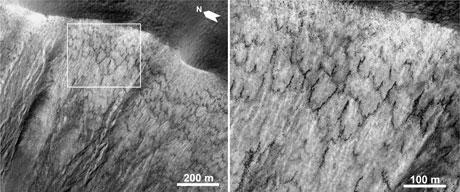 |
| The surface of Mars displays a diverse landscape, and a new study shows that large areas of the northern hemisphere have undergone a number of freeze-thaw cycles. (Credit: Image courtesy of University of Gothenburg) |
When the ice melted, the near-surface sediment on the slopes became saturated with the melt water and then slowly began to move downwards on top of the still frozen permafrost table due to gravity.
“You can see these structures in close proximity to what are known as gullies,” says Andreas Johnsson.
The researchers have long suspected that the gullies, which are geologically young landforms, were formed by liquid water.
“Our question was: if liquid water can occur in local niches, predominantly in impact craters, where most of the gullies are to be found, then shouldn’t we see more signs of thawing and the effects of melt water, along the lines of those in our own Arctic environments?”
In the study, which focuses on the northern hemisphere of Mars, the researchers could see lobate features in close proximity to the gullies. Morphologically similar landforms are also to be found in Arctic areas on Earth, and are known as solifluction lobes.
Transient liquid water is also of considerable interest when looking for favourable environments for life on Mars. Research has shown that organisms can survive for long periods without water in cold environments on Earth, but that there must be access to water at times.


No comments:
Post a Comment