While many bacteria exist as aggressive pathogens, causing diseases ranging from tuberculosis and cholera, to plague, diphtheria and toxic shock syndrome, others play a less malevolent role and some are critical for human health.
In a new study, Cheryl Nickerson and her group at ASU's Biodesign Institute, in collaboration with an international team including Tom Van de Wiele and lead author Rosemarie De Weirdt at Ghent University, Belgium, explore the role of Lactobaccilus reuteri -- a natural resident of the human gut -- to protect against foodborne infection.
Their results demonstrate that this beneficial or probiotic organism, which produces an antimicrobial substance known as reuterin, may protect intestinal epithelial cells from infection by the foodborne bacterial pathogen Salmonella.
The study examines for the first time the effect of reuterin during the infection process of mammalian intestinal cells and suggests the efficacy of using probiotic bacteria or their derivatives in future therapies aimed at thwarting Salmonella infection.
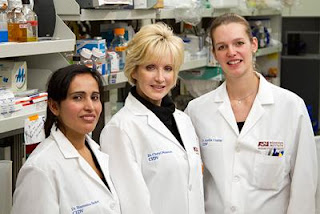
Members of the Nickerson lab at the Biodesign Institute's Center for Infectious Diseases and Vaccinology involved in this study were Shameema Sarker and Aurélie Crabbé.
Results of the new study recently appeared in the journal PLoS ONE.
Cell cultures: Now in 3-D
Over the past decade, the Nickerson group and their colleagues have developed organotypic three-dimensional (3-D) tissue culture models of the small and large intestine, lung, placenta, bladder, neuronal tissue and vaginal epithelium that mimic key characteristics of the parental tissue, and applied them to study the infectious disease process. Such models offer exciting new insights into host-pathogen interactions, cell proliferation, differentiation and immune function, and are providing a platform to understand normal tissue homeostasis and transition to disease.
For the current study, 3-D colon epithelial cells were used. Nickerson explains that cells derived for study through this technique more faithfully approximate key in vivo responses to S. Typhimurium infection, compared with the traditional monolayer methods, making such cells an ideal model to observe infection processes.
3-D cell culture models are cultured in a special environment within a device known as a Rotating Wall Vessel bioreactor -- a cylindrical, rotating apparatus, filled with a culture medium supplying essential nutrients, oxygen and physical forces to the cells. Within the reactor, the natural sedimentation of cells due to gravity is balanced by the bioreactor's rotation, resulting in a gentle tumbling of cells within the media in the chamber.
During the culturing phase, cells attach themselves to tiny porous beads, termed microcarriers, or other scaffolding. Under these conditions, cells are able to respond to molecular and chemical gradients in three-dimensions in a way that approximates their behavior under in vivo conditions, causing the cells to aggregate based on natural cellular affinities and form 3-D tissue-like structures.
"In previous studies, we applied our 3-D intestinal cell cultures as human surrogates to further our understanding of how Salmonella interacts with the intestinal epithelium to cause gastrointestinal disease," Nickerson explains. "We found that these models were able to respond to infection in key ways that mimicked the parental tissue in vivo and which conventional models could not recapitulate. We are excited to advance the use of our 3-D models in the current work to study how commensal intestinal microbes and their products can protect against Salmonella-induced foodborne infection. The results of this study may provide fundamental knowledge for development of new probiotics and other functional food based strategies."
While the authors stress that much work remains, particularly in terms of understanding reuterin's role in the context of a complex gut microbiome, the results are encouraging and suggest a new avenue for fighting Salmonella infection, through the process of glycerol conversion to reuterin by L. reuteri.
In a new study, Cheryl Nickerson and her group at ASU's Biodesign Institute, in collaboration with an international team including Tom Van de Wiele and lead author Rosemarie De Weirdt at Ghent University, Belgium, explore the role of Lactobaccilus reuteri -- a natural resident of the human gut -- to protect against foodborne infection.
Their results demonstrate that this beneficial or probiotic organism, which produces an antimicrobial substance known as reuterin, may protect intestinal epithelial cells from infection by the foodborne bacterial pathogen Salmonella.
The study examines for the first time the effect of reuterin during the infection process of mammalian intestinal cells and suggests the efficacy of using probiotic bacteria or their derivatives in future therapies aimed at thwarting Salmonella infection.
Members of the Nickerson lab at the Biodesign Institute's Center for Infectious Diseases and Vaccinology involved in this study were Shameema Sarker and Aurélie Crabbé.
Results of the new study recently appeared in the journal PLoS ONE.
Cell cultures: Now in 3-D
Over the past decade, the Nickerson group and their colleagues have developed organotypic three-dimensional (3-D) tissue culture models of the small and large intestine, lung, placenta, bladder, neuronal tissue and vaginal epithelium that mimic key characteristics of the parental tissue, and applied them to study the infectious disease process. Such models offer exciting new insights into host-pathogen interactions, cell proliferation, differentiation and immune function, and are providing a platform to understand normal tissue homeostasis and transition to disease.
For the current study, 3-D colon epithelial cells were used. Nickerson explains that cells derived for study through this technique more faithfully approximate key in vivo responses to S. Typhimurium infection, compared with the traditional monolayer methods, making such cells an ideal model to observe infection processes.
3-D cell culture models are cultured in a special environment within a device known as a Rotating Wall Vessel bioreactor -- a cylindrical, rotating apparatus, filled with a culture medium supplying essential nutrients, oxygen and physical forces to the cells. Within the reactor, the natural sedimentation of cells due to gravity is balanced by the bioreactor's rotation, resulting in a gentle tumbling of cells within the media in the chamber.
During the culturing phase, cells attach themselves to tiny porous beads, termed microcarriers, or other scaffolding. Under these conditions, cells are able to respond to molecular and chemical gradients in three-dimensions in a way that approximates their behavior under in vivo conditions, causing the cells to aggregate based on natural cellular affinities and form 3-D tissue-like structures.
"In previous studies, we applied our 3-D intestinal cell cultures as human surrogates to further our understanding of how Salmonella interacts with the intestinal epithelium to cause gastrointestinal disease," Nickerson explains. "We found that these models were able to respond to infection in key ways that mimicked the parental tissue in vivo and which conventional models could not recapitulate. We are excited to advance the use of our 3-D models in the current work to study how commensal intestinal microbes and their products can protect against Salmonella-induced foodborne infection. The results of this study may provide fundamental knowledge for development of new probiotics and other functional food based strategies."
While the authors stress that much work remains, particularly in terms of understanding reuterin's role in the context of a complex gut microbiome, the results are encouraging and suggest a new avenue for fighting Salmonella infection, through the process of glycerol conversion to reuterin by L. reuteri.


No comments:
Post a Comment